- Home
- Works & Tech
- Local Resources × Websites: Tourism Promotion Case Studies
Tech ArticlesWeb
Local Resources × Websites: Tourism Promotion Case Studies
In regional revitalization and tourism promotion, how accurately and attractively a region "presents" its inherent appeal, such as its culture, nature, and history, is extremely important.
Now that information delivered through print media alone is reaching people less and less, strategic communication using websites has become key.
In this article, we explain the key points of producing and running websites, along with success stories of tourism promotion that used websites to showcase local resources to the fullest.
- Why linking local resources and websites matters
- Five keys to website production that delivers results
- [Case Study] Building a website that makes the most of local resources
- Points to note and tips for avoiding failure when using websites
- Summary
Why linking local resources and websites matters
The reality: "local strengths" are not reaching people
Every region has attractive resources such as locally rooted culture, historical background, rich nature, and specialty products.
However, the reality is that these are not reaching potential tourists.
The following issues have become apparent:
- Social media allows only fragmented communication, making it hard to convey the appeal
- Information that is not updated loses credibility
- Without multilingual support or smartphone optimization, sites are unfriendly to international tourists
These issues can be solved systematically and continuously through a strategically designed website.
Tourists' decisions are "digitally driven"
In recent years, tourists' travel planning has followed behavior patterns like these:
- Gathering information through Google searches and social media
- Checking details and booking on official websites
- Looking things up in real time on smartphones
In fact, one survey found that more than 80% of people refer to web searches or official websites when planning a trip.
In other words, a website is the "first point of contact" with tourists and the center of the path that leads to "visits and bookings."
Five keys to website production that delivers results
Websites that effectively convey local resources and attract tourists share common success factors.
1. Clarify the target and design personas
- Define the audience specifically, such as international visitors, women in their 20s, or families
- The site structure is determined by designing "who will visit, and why"
- Optimize the content and design tone for the target as well
2. Turn local resources into stories
- Instead of simply introducing sights "to look at," convey the background and the people's stories
- Articles and columns featuring the voices of local residents and producers are effective
- "Travel stories" create empathy and increase the desire to visit
3. Visual appeal through photos and video
- Strengthen the "I want to go there" impression with visuals by professional photographers
- Swap photos by season to meet demand from repeat visitors
- Also make use of drone footage and experience videos
4. Multilingual support and mobile optimization
- Multilingual support, such as English, Chinese, and Korean, is the basis of inbound tourism measures
- Mobile-first design optimizes the UX on smartphones
- Audio guides and attention to accessibility are also valued
5. User flow design and CTA placement
- Naturally design a flow of spot introductions → event booking → access information
- Place CTA buttons for actions such as "Book" and "View map" throughout the site
- Integration with Google Maps and experience booking sites is also effective
[Case Study] Building a website that makes the most of local resources
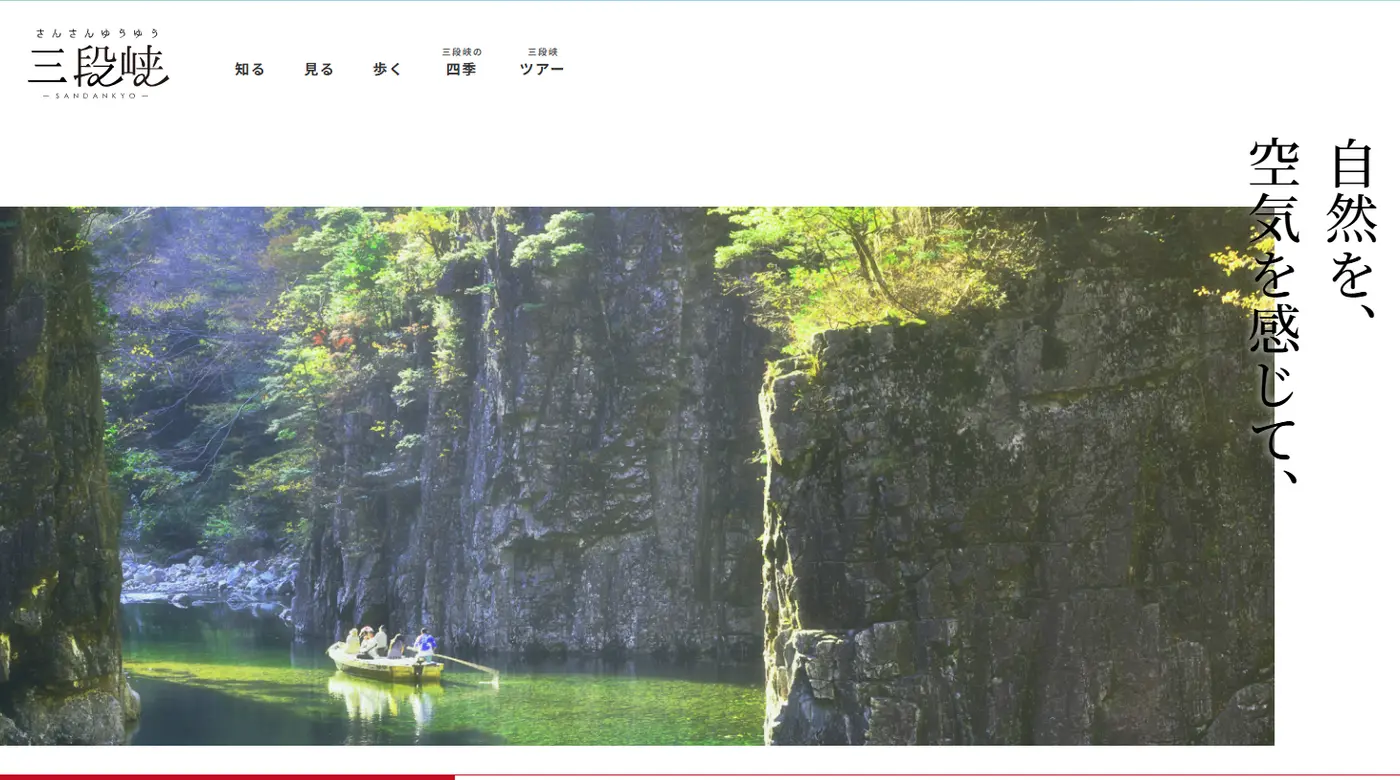
Sandankyo Gorge tourism portal site (Akiota Town, Hiroshima Prefecture) | Produced by World Area Networks Co., Ltd.
Background and challenges
• Information centered on Sandankyo Gorge, the best-known tourist spot in Akiota Town, was not consolidated, making it hard for tourists to find the information they needed
• Because information relied mainly on social media and word of mouth, the region's appeal was not communicated systematically
• Attracting visitors by making use of the natural beauty of the four seasons and experiential content was a challenge
What we did
• Adopted a visually driven design that makes use of the gorge's natural beauty and tourism resources, with a structure that increases the desire to visit
• Organized tourism content across multiple categories, such as highlights, ferry boats, and tours, and clarified user flows
• Enhanced map-linked spot search, access information, and FAQs, with use both before the trip and on site in mind
• Set up an update system using a CMS (WordPress), enabling the local government and tourism association to run the site themselves
Points to note and tips for avoiding failure when using websites
The risk of stalled updates
- Even if a site attracts attention right after launch, its effect drops quickly once updates stop
- It is important to build a system in which local staff can update information using a CMS (such as WordPress)
Cramming in too much information
- There are many cases where sites cram in so much appeal that users get lost
- The basic approach is to organize information hierarchically and provide paths for each purpose
Insufficient coordination among local stakeholders
- If coordination with the local government, tourism associations, chambers of commerce, and others is weak, information updates and project implementation stall
- Rather than leaving it all to the production company, building a structure in which the whole region runs the site together is key to results
Summary
- A systematically designed website is essential for communicating the appeal of local resources
- The keys to success are "target design," "story structure," and "visual appeal"
- Multilingual and UX support from an inbound perspective is also important
- Setting up an operating structure and update scheme is key to long-term success
To regions and organizations looking to strengthen tourism promotion
WAN provides end-to-end support, from web strategy planning for tourism promotion to producing and running websites that make use of local resources.
If you have concerns such as "we have no one with digital expertise" or "we don't know how to present our appeal," please consider our tourism promotion support services.
→ Free consultations and document downloads are available here.