- Home
- Works & Tech
- This Is 4D Gaussian Splatting! An Astonishing Real-Time Rendering Technology
This Is 4D Gaussian Splatting! An Astonishing Real-Time Rendering Technology
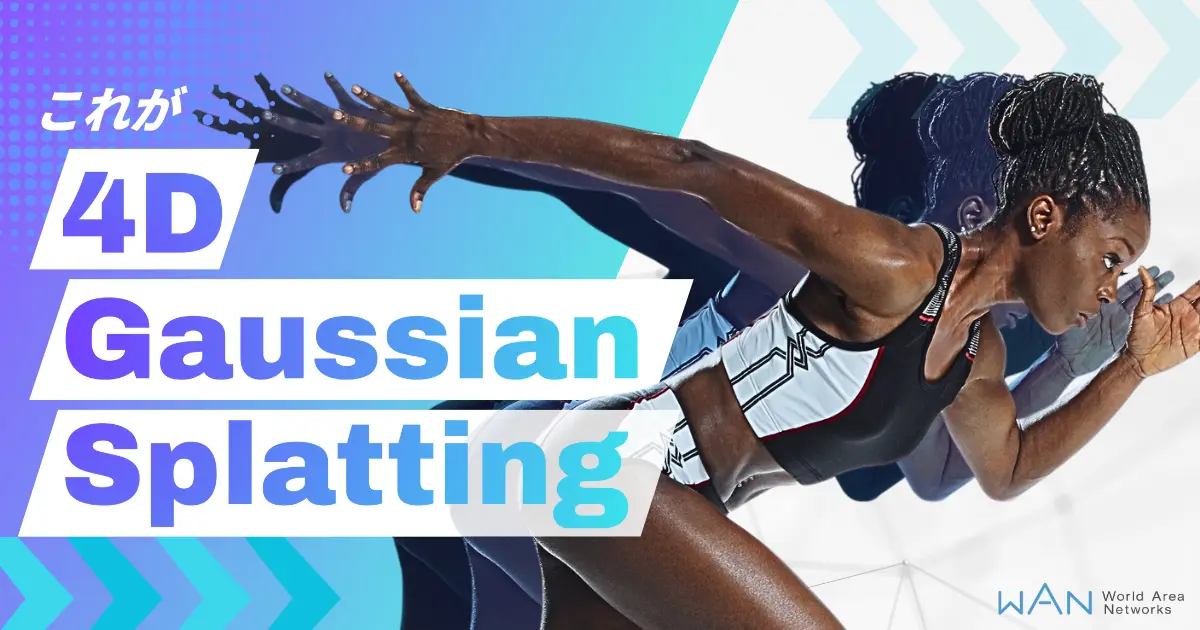
Incredibly Smooth 3DCG Moving in Real Time
That future is already becoming reality.
"Gaussian Splatting" is a new rendering method that has been attracting attention since 2023. Its evolution, "4D Gaussian Splatting," enables visual expression that includes the time axis, and is drawing worldwide attention as a technology that is rewriting the rules of real-time rendering.
In this article, we explain the following in an easy-to-understand way, including the latest developments:
- The basic concept and background of 4D Gaussian Splatting
- How it differs from conventional methods and its technical breakthroughs
- Real-world use cases and potential
- Points to note when adopting it, and future outlook
This is a must-read for anyone interested in 3DCG, digital twins, and XR technology.
What Is 4D Gaussian Splatting? Background and Why It Is Attracting Attention
In recent years, advances in NeRF (Neural Radiance Fields) and 3D scanning technology have brought dramatic progress in point cloud processing and view synthesis.
Against this backdrop emerged "Gaussian Splatting," a rendering method that achieves extremely smooth and realistic rendering by assigning Gaussian distributions to point clouds.
"4D Gaussian Splatting" adds the concept of a time axis (= 4D) to this technology, making it possible to render dynamic 3D spaces in real time.
Why Is It Attracting Attention Now?
- Fast real-time rendering: overwhelmingly faster than conventional NeRF
- Lightweight, meshless design: no complex polygons needed, and a simple data structure
- Handles change over time well: can render movement and changes in facial expression naturally
- Reuse of multi-camera footage: high-quality 3D representation even from a small number of frames
Content that drew attention at the GTC conference held in March 2025
How 4D Gaussian Splatting Works and What Makes It Innovative
4D Gaussian Splatting is not just a point cloud visualization technique; its innovation amounts to a paradigm shift in the rendering method itself.
Gaussian-Based Point Cloud Rendering
In ordinary point cloud processing, each point holds only coordinate information, but in this method each point (splat) has the following attributes:
- Color
- Opacity
- Orientation
- Shape (Covariance)
This achieves both smoothness and realism that conventional polygon rendering could not express.
4D Processing with Time-Series Information
4D Gaussian Splatting adds "time axis" information to the splats, making it possible to render changing 3D spaces in real time.
- Human movements and gestures
- Moving cars and deforming objects
- Swaying trees and changing facial expressions
The ability to naturally reproduce such dynamic changes is the decisive difference from NeRF and conventional methods.
Compatibility with Fast GPU Processing
Gaussian-based computation works extremely well with GPUs (especially NVIDIA GPUs), achieving low-latency rendering.
This makes it ideal for applications such as:
- Interactive experiences using game engines
- Immersive expression in VR spaces
- Real-time monitoring with digital twins
WAN's Gaussian Splatting Production Work
At World Area Networks Co., Ltd., we handle everything in-house, from aerial drone filming to 3D visualization using Gaussian Splatting.
We put this technology to practical use in a variety of projects, including our own product currently in development.
In particular, our development capability to adopt the latest technologies such as Gaussian Splatting early and turn them into real-world operations is one of our strengths.
We will continue to actively adopt cutting-edge technologies in video, spatial, and data processing, and provide high-quality solutions that meet the needs of our clients and society.
Potential Applications and Use Cases from Real Examples
4D Gaussian Splatting is expanding beyond research into real industrial applications.
1. Digital Twins (Virtual Reproductions of Cities and Factories)
- Visualize factory operations and logistics flows in real time with 4D splatting
- Reconstruct urban traffic flows and people's movements from limited sensor data
2. VR/AR Content Production
- Represent scan-based characters in 4D to deliver more realistic experiences
- Make backgrounds and environments change dynamically to enhance immersion
3. Video Production and VFX
- Generate CG compositing assets directly from filmed footage
- No polygon editing required, significantly reducing production man-hours and costs
Expectations for Future Technical Advances
- Native integration with Unity and Unreal Engine
- Lightweight operation on smartphones
- Lower costs through the spread of automated capture devices
Within the next two to three years, 4D Gaussian Splatting is likely to become a standard technique in video production and industrial applications, so it is important to keep track of developments now.
Summary
- 4D Gaussian Splatting is "an innovative rendering technology that includes the time axis"
- It requires no meshes and enables smooth, fast real-time rendering
- Applications are expected in many fields, including digital twins, VFX, and VR/AR
- There are challenges in data capture and tool support, but the technology is advancing rapidly
Leave the Adoption of XR and 3DCG Technology to WAN
At World Area Networks, our experienced staff provide end-to-end support, from strategy planning to execution for XR, the metaverse, spatial staging, and more.
If you are struggling with a lack of technical resources or choosing the right means of expression for 3DCG and digital staging, please consider WAN's XR content production support service.
For detailed consultations and free brochure downloads, please see the link below.